
June 25, 2007
Confirmation scams
To: Employees
Re: Scams
The Wall Street Journal just called to try and upgrade my subscription.
Recently I've seen the WSJ arriving here, but I never ordered it. Yet, according to the caller, we've got a subscription in my name.
I'm also getting a men's lifestyle magazine that I'd never even heard of.
Most likely these subscriptions will result in a bill, and it may even get paid. The product is arriving, right? Shouldn't it be paid for?
As our company gets larger, it's harder and harder to protect against "order confirmation" scams.
An order confirmation scam usually starts with a phone call to a random employee who is asked to "confirm" something. The caller doesn't ask "Do you want to subscribe to my magazine?" The caller says "I'm calling from Magazine regarding your subscription, and just want to confirm that your address is 1313 Commercial St., etc..."
Your innocent fact confirmation is recorded as an order.
Well, if they're bad guys, why do they call at all? Why not just send the product and the bill, or even just the bill? They do, but those bills are (usually) easier and safer to ignore. The problem is the "pseudo-legit" businesses, or truly legit businesses (like the WSJ) who hire smarmy outside firms to find new customers. The WSJ requires their partners to send in legitimate subscriptions. And if we complain, they'll check the records, and there will be a note that on March 12, the sales person called us, talked to
Magazine subscriptions are usually a cheap annoyance. That's why they're popular for this kind of scam -- it's not worth our time to argue every un-authorized $19.95 subscription.
The office supply scams are the real killers. "Hi, I'm Sue from HighwayRobberyToner.com. I'm calling about your order; it doesn't have your printer model number on it. Can you tell me if that's the HP 5100? Oh, it's the HP 7100? Great. We'll get those cartridges right out to you."
Yep. It sure didn't have our order number on it, because Sue just wrote it up. But now it does, and some employee's name to authorize the purchase. The bolder companies will fax the order to you to review and even sign. Then (actual case here) we're shipped a very cheap toner cartridge at 2-300% of normal cost, with a signed order authorization. (Fortunately our receivables clerk catches most of these scams. But it wastes a lot of time.)
Bottom line: If you're asked to confirm something that you didn't originally order, start by saying that you're not authorized to make a purchase.
"I'm not authorized to make a purchase, but I can confirm that our address is 1313 Commercial St."
If you're at all suspicious about a call (which you should be if you didn't place the order) please send it to the person who most likely placed the order, or to a manager.
Thanks for being on guard for fraud, and for helping to protect me from magazines full of men's fashion tips. (As if I need that!)
Posted by Bob Pritchett at 10:54 AM | TrackBack
April 27, 2007
That’s my girl...
My 11 year old daughter recently attended a baby-sitting class. One of the first observations she shared afterwards was her calculation of the teacher’s gross revenue for the day.
Posted by Bob Pritchett at 9:13 AM | TrackBack
February 21, 2007
EntrepreneurshipWeek USA
The Kauffman Foundation is sponsoring EntrepreneurshipWeek USA, February 24-March 3, 2007. It is all about the importance of being entrepreneurial -- something that goes beyond just starting a business, encompassing entrepreneurial thinking in non-profits, within existing organizations, and more.
Next week's activities range from invention contests to lectures to business movie nights. Check out the nationwide directory and find something in your area. And if you're near Tacoma, Washington, please join me Tuesday night at the University of Puget Sound for my talk "Don't Wait: Why You Should Start a Business Before You Turn 25".
Posted by Bob Pritchett at 9:27 PM | TrackBack
January 18, 2007
Entrepreneurs are the ones sleeping on the floor
I was walking through a retail business with the owner and saw some bedding in the back office. “Working late?” I asked.
He explained that late one night he found his front door locks inoperable. He couldn’t purchase a replacement at that hour, and didn’t want to pay emergency rates for a locksmith, so he had his wife drop off some bedding and he slept on the floor.
As you grow a business you learn to delegate. You give other people some of the chores you used to do yourself. You become a manager. But in times of crisis you can distinguish managers and entrepreneurs. Entrepreneurs will sleep on the floor.
Posted by Bob Pritchett at 6:44 AM | TrackBack
July 13, 2006
Dress up for revenue
Can you make more money by dressing better? How about eight times the revenue? At a lemonade stand. (Thanks, Business Opportunities.)
Posted by Bob Pritchett at 9:24 AM | TrackBack
June 24, 2006
Business inspiration from unusual sources
Back in 1997 my business was going through a difficult period. I was feeling low because it seemed everyone else had a bigger, better business model. Dot-com’s were popping up with plans to reinvent whole industries, and we were doing old-style software in a niche market without much Internet pixie dust.
Forbes magazine arrived with the story of Wendell Murphy, billionaire pig farmer, and suddenly I felt better. I was encouraged just knowing that you could start from mud (literally) and build a huge business in something as low tech as pig farming.
The Unusual Business Ideas That Work blog is full of that kind of business inspiration. (Thanks bBlog!)
Posted by Bob Pritchett at 5:51 AM | TrackBack
June 20, 2006
Work / Life Balance
In church Sunday a verse caught my eye and reminded me again why the Bible is still the ultimate business book:
10 He who loves money will not be satisfied with money,
nor he who loves wealth with his income;
this also is vanity.
11 When goods increase,
they increase who eat them,
and what advantage has their owner
but to see them with his eyes?
12 Sweet is the sleep of a laborer,
whether he eats little or much,
but the full stomach of the rich will not let him sleep.
"Work / life balance" is on the agenda at every business or entrepreneurship conference. Solomon had the subject nailed thousands of years ago; he continued:
18 Behold, what I have seen to be good and fitting is to eat and drink and find enjoyment in all the toil with which one toils under the sun the few days of his life that God has given him, for this is his lot. 19 Everyone also to whom God has given wealth and possessions and power to enjoy them, and to accept his lot and rejoice in his toil—this is the gift of God. 20 For he will not much remember the days of his life because God keeps him occupied with joy in his heart.
Ecclesiastes 5:10-12, 18-20, ESV
Enjoy the work and the reward, whether it be small or large. That is work / life balance.
Posted by Bob Pritchett at 5:41 AM | TrackBack
May 23, 2006
People choose the easiest solution
In general, web sites are poor substitutes for specialized software applications installed on your local machine.
For almost any web application there is a superior software package. It is true even for things we think of as “made for the web” applications: In 1996 United Connection, a Windows application that got data over the Internet, was a better airline reservation tool than most travel sites available now. Copernic offers a richer interface and more full featured search tool than Google by using Google, and other engines, through its own rich interface.
But in most cases the web application beats the pants off the desktop application in number of users and market share. Because, as Dennis Forbes puts it, Rate of Adoption = Ease of Setup, and typing a web address is a pretty easy setup.
It is a hassle to setup even the simplest of software applications, and then you have to keep it up to date, move it to your new machine, install it on your laptop, etc. Simple as these tasks may be, they are obstacles to adoption, especially when the alternative is visiting a web site.
This is not a software principle. It is a general business principle.
I have let numerous magazine subscriptions lapse because the renewal notice didn’t offer credit card renewal. I don’t write checks in the day of electronic bill pay, and I don’t want to get another bill later. I just want to provide my credit card info and be done. In fact, I want my subscription automatically renewed every year, at the best available price, until I say otherwise on an easy-to-use magazine web site.
Yes, I am that lazy. And so are lots of customers. Every little thing you can do to make it easier to do business with you and to use your product or service will improve your rate of adoption.
Posted by Bob Pritchett at 9:22 AM | TrackBack
March 31, 2006
What is your entrepreneurial IQ?
Mine is 78. (I don’t care enough about money. I’ll work on that.)
"You have several characteristics that indicate entrepreneurial potential. This means that for the most part, you possess the personality traits and skills typically found in entrepreneurs. You would be well-equipped to tackle the difficult task of owning your own business."
Whew!
Bill Wagner’s quiz was fun; I found the questions as interesting as the analysis. (Thanks Startup Fever and Business Opportunities.)
Posted by Bob Pritchett at 5:00 AM | TrackBack
March 24, 2006
When simpler would be better
My wife's garage door opener stopped working.
The remote rattled when you moved it, so I suspected an easy fix. Looking to impress the family with my long-lost skills in electronics, I pried it open and diagnosed the problem: the little switch thingy (technical term) had broken off the circuit board.
I declared victory and went looking for my soldering iron. I pawed through every box of childhood detritus in the basement. I found solder, wire, resistors, and diodes, but not the soldering iron. I went and bought a new one. Finally, over spread newspapers on the kitchen table, I began electronic surgery as my children looked on in fascination.
A half-hour later the children were gone. I was sitting alone amidst the metallic droppings of many failed attempts to solder the tiny switch in place when my wife came in.
"Why don’t you just use a piece of tape?" she asked.
My wife is wonderful, but obviously not very technical. I explained to her why that was a completely ridiculous suggestion. Then, after she left, I got a piece of transparent tape from the children's school supplies and firmly fastened the switch in position. It has functioned perfectly ever since.
It is always fun, both at home and at work, to come across a problem to which you can apply all your tools and skills. But before you build the web site, create the database, or bring in the attorneys, ask yourself if the cheaper, faster, better solution wouldn't be a clipboard, a file folder, a phone call, or a piece of tape.
Posted by Bob Pritchett at 4:58 PM | TrackBack
February 13, 2006
Dream the possible dream
 I lived in Philadelphia during college, and regularly used the ATM outside a nearby bank. It was a quiet location late at night, and I was always a bit wary when using the ATM. When word spread of a student being held up at that machine and forced to enter their PIN, I decided to get my cash elsewhere.
I also started thinking about ways to improve security. I came up with the idea of letting users enter their PIN number backwards. Without stopping the transaction, the ATM could silently summon police, mark the surveillance footage for review, etc.
I liked my little idea, and, being of an entrepreneurial bent, I gave some thought to what I could do with it. My conclusion: nothing.
- The idea was too simple to have value. Saying it aloud communicated it completely, and I had nothing to add beyond that.
- Implementation would require changes in infrastructure that I could not mandate, and an education of the public that I could not accomplish.
- The benefit was too small. Not enough people are held up at ATM’s.
(In response to proposed legislation, the State of Illinois came up with lots of other reasons this is a weak idea.)
The problem with the entrepreneurial credo "Never give up on your dream!" is that everybody has stupid dreams. Entrepreneurial success is not about never giving up on any idea. Entrepreneurial success is about identifying a great idea that you are able to implement and then sticking with the hard work of execution.
Fortune Small Business has the story of Joseph Zingher, who came up with the PIN-number-backwards idea in 1994, patented it, and tried to turn it into a business. What did it get him? He is 47, broke, living with his brother, and ranting about the "brain-dead zombie" bankers he wishes were his customers. He has lowered the price for the first state to $0, and still has no takers. (Forbes has more on Zingher's quest.)
State legislatures may yet come to his rescue, but I still hurt (as a fellow-imaginer of the same idea) for Zingher and his wasted years. His idea is not a bad idea; it is just not a great idea. And more importantly, it is an idea the success of which can never be in his control: Zingher doesn't run a bank or manufacture ATM's.
Never give up on your dream. But dream something you can do, not something others would have to do for you. And dream something big enough to be worth the effort.
Posted by Bob Pritchett at 4:00 AM | TrackBack
January 31, 2006
"Checks and money orders that I receive will be shredded."
Long ago, when I was a teenage entrepreneur, I spent a few hours with John T. Reed. In one afternoon he gave me a specific piece of advice on pricing that made me thousands of dollars. He also illustrated, through stories and the example of his business, the power of understanding exactly what you want to do and structuring your business around that understanding.
I love the How to Order page on Reed's web site, which explains why orders for his books are not accepted by phone, fax or mail. It is so far from the standard idea of customer-friendly that it borders on customer-hostile. But that is the point: it is friendly to the customers he wants and repulsive to the customers he doesn't want. Reed is focused on the customers he wants and on the service he is willing to provide. And he has the sense to know that there are lots of customers not worth having, particularly for his low-overhead operation.
Does ten percent of your overhead go to problems with one percent of your customers? Could you redesign your business to exclude a whole class of service problems?
Posted by Bob Pritchett at 4:00 AM | TrackBack
January 13, 2006
Shoe Shine Guy
 I am too lazy to shine my own shoes. So when I am in a Nordstrom store I stop by the usually very quiet, very empty shoe shine stand.
I always figured that Nordstrom runs shoe shine stands as marketing tools, to reinforce their brand message of quality shoes and incredible service. At $2.50 a shine for a labor-intensive service offered inside, off the street, how can there be enough customers to call it a business?
There probably can't be, if you think of it that way. But a walk through a different Nordstrom shoe department taught me that you don't have to think of it that way.
At this Nordstrom the shoe shiner had all his seats occupied; when he saw me nearby he called out that he would be available quickly.
Once seated, I asked the young man if he shined shoes full time. "Yes," he told me, "it is how I make my living, and I appreciate your business." When I lamented that I lived too far away to visit regularly, he suggested I drop off a bag of shoes when driving by, promising quick service. He gave me a card and offered to shine shoes I mailed to him. And as he worked he kept recruiting customers from passers by, queuing them up and keeping the seats filled.
He got a good tip, and I got more than a good shine: I got another lesson in how a little hustle and a great customer service attitude can line up business at the quietest of locations.
Posted by Bob Pritchett at 4:00 AM | TrackBack
January 2, 2006
Three cents daily
Over the years many people have inquired about buying my company. These calls used to be pretty exciting. Like many small businesses, we were convinced that our core problem was undercapitalization. I saw a deep-pocketed acquirer as a way to address our tight financial circumstances and light the growth rocket, so whenever one came calling I rolled out the red carpet, opened the books, and started talking numbers.
Nobody ever closed the deal, and now I know why: they were smart deep-pocketed acquirers.
Our problem wasn’t undercapitalization, it was lack of discipline. And with no deep pockets to prop us up we were forced to develop that discipline in order to survive. What a blessing it is to be undercapitalized.
Today I still get calls from people who want to buy or invest in our company. I politely explain that we are now able to fund ourselves internally. Still some insist on asking "How much to buy Logos?"
I never know what to say, since I don't want to sell. But now I have found a century old quotation that provides some guidance. When William Randolph Hearst inquired about the cost of buying of James Bennett’s New York Herald, the reply was a telegram:
"Price of Herald three cents daily. Five cents Sunday. Bennett."
Posted by Bob Pritchett at 6:00 AM | TrackBack
December 20, 2005
Promoting Entrepreneurship
The Economist has a write up on Carl Schramm at the Kauffman Foundation, which exists to encourage entrepreneurship.
I have read a number of books, and participated in programs, that came out of the Kauffman Foundation, and I applaud what they are doing. I have also thought that it is really difficult to have a foundation effectively promote something like entrepreneurship, which is so often a very personally motivated behavior. This article is an interesting look at what Kauffman is doing, and the challenges Schramm faces in leading it.
It also provides a link to the cool Hot Shot Business site, where kids can play business in an impressive simulator. My candy shop has already been smoked by the competition....
Posted by Bob Pritchett at 6:51 AM | TrackBack
December 16, 2005
Learning from failure in The Entrepreneurial Code
Christopher Cononico tells the story of his business failure in The Entrepreneurial Code, a fascinating blow-by-blow of a student start-up in the pre-dotcom days. (This Case Story, as he calls it, is posted online for free.)
The problem with "we hung on by our fingernails, we rolled the dice for payroll, and we made it" tales of entrepreneurial success is that you only hear about the ones who made it. Fed a steady diet of back-from-the-brink-with-a-big-gamble stories, you can start to believe that they are the cause of success, rather than an unfortunate detour along the way.
Failure is a great teacher, but too often its valuable lessons benefit only those it touches. We nurse our wounds in private and hoard our expensive education. There are not enough books and speakers on the topic of "How I went bankrupt and hurt my friends and family."
Cononico is up front about the mistakes he made and the consequences of his bad business decisions. He has done a great service by sharing his experience for the benefit of entrepreneurs who follow him.
Posted by Bob Pritchett at 6:15 AM | TrackBack
December 13, 2005
"Over my dead body..."
"The day I'm laid out dead with an apple in my mouth is the day we'll pay commissions. If you pay commissions, you imply that the small customer isn't worth anything."
Bernard Marcus, co-founder of Home Depot, in Fortune in 1993 (by way of The Quotable Tycoon)
Now that is business leadership.
There is a reason people start businesses: to do things their own way. Advice and consensus are useful tools, but if you are an entrepreneur, you are the reason you are in business. Don’t be afraid to draw some lines in the sand. If you succeed in giving your business your values, in promoting and defending them in fair weather and foul, they might even last after you are dead.
Posted by Bob Pritchett at 6:38 AM | TrackBack
December 12, 2005
Small Business vs. Entrepreneurship vs. Lifestyle Business
Peter I. Hupalo has an excellent article on the difference between small business and entrepreneurship. (Thanks BattleMan via Cash Flow Blog.)
I share Peter's perception of the small business label: Mom and Pop living above the store. This is buying yourself a job, and one with a terribly demanding boss at that. Choosing the label entrepreneur is choosing growth. It may be a small business, at least for a while, but entrepreneurs call it "a growing business". When you say "I'm going to run a small business," you're practically guaranteeing it. Forever, or at least until it dies. (Because, if you are not growing, you are shrinking.)
I'm not saying that every restaurant needs to become a chain, or that every bead shop needs to become an arts and crafts supercenter. But every self-described small business owner who is not focused on growth is probably a hobbyist (in it for love, not money), a slave (opens, closes, can't go on vacation), or an impending failure (insert-big-percentage of small businesses fail each year).
Yes, I do believe in lifestyle businesses, but a lifestyle business is just a growing business where the growth supports your lifestyle, whether it is taking time off, traveling where you want, or pursuing your personal passions through the work of the business. Running forever on the small business treadmill isn't a lifestyle, it's a life sentence.
Posted by Bob Pritchett at 8:47 AM | TrackBack
December 10, 2005
Deadlines make things happen
Fort Worth Business Press has the teen-entrepreneur story of Justin Avery Anderson, an 18 year old freshman at TCU who is two years into a moist granola business. It is a classic of the genre: kid makes a product he likes, friends and family love it, local market takes it on, Mom and friends pitch in to ramp up production.
What I like are the deadlines. Justin isn't just getting the “Hey, kids! Let's put on a show!” introduction to entrepreneurship. He lost his kitchen at the last minute and had to cold call all the caterers in town in order to deliver an order. When the market wanted to delay the launch of his fresh product for paperwork he put a deadline on them by arranging media coverage. Deadlines moved Justin's business ahead.
I love deadlines. Not the soft, self-imposed deadlines of personal goal setting, but the heavy, dangerous, externally imposed, stress-inducing, business-life-threatening deadlines that must-be-met-or-we're-dead.
Actually, I hate deadlines. I just love how they make things happen.
Posted by Bob Pritchett at 9:33 AM | TrackBack
December 6, 2005
Practical Articles for Entrepreneurs
Joseph Hadzima, at MIT, has written a series of great articles on practical issues in entrepreneurship. The articles are short, clear overviews of subjects many new entrepreneurs don't think about.
Posted by Bob Pritchett at 7:00 AM | TrackBack
December 2, 2005
Whiteboard Elves
My partner and I started our company as a hobby project to keep up our programming skills. Today, of course, I don’t do any programming; my time is consumed by management and strategy and a million other things.
A conversation with someone in our text processing department led me to imagine a small utility program to facilitate keyboarding in ancient languages. A few years ago I would have written something like this myself, but I don’t have the time now. So I drew this diagram on a whiteboard.
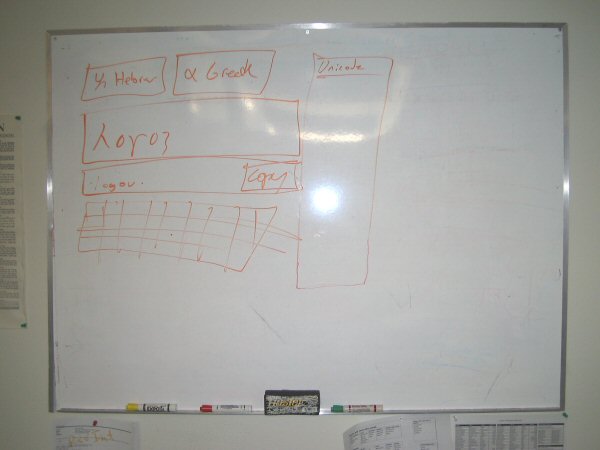
The next afternoon I returned to the office with the whiteboard and a programmer showed me the first working version of this program.
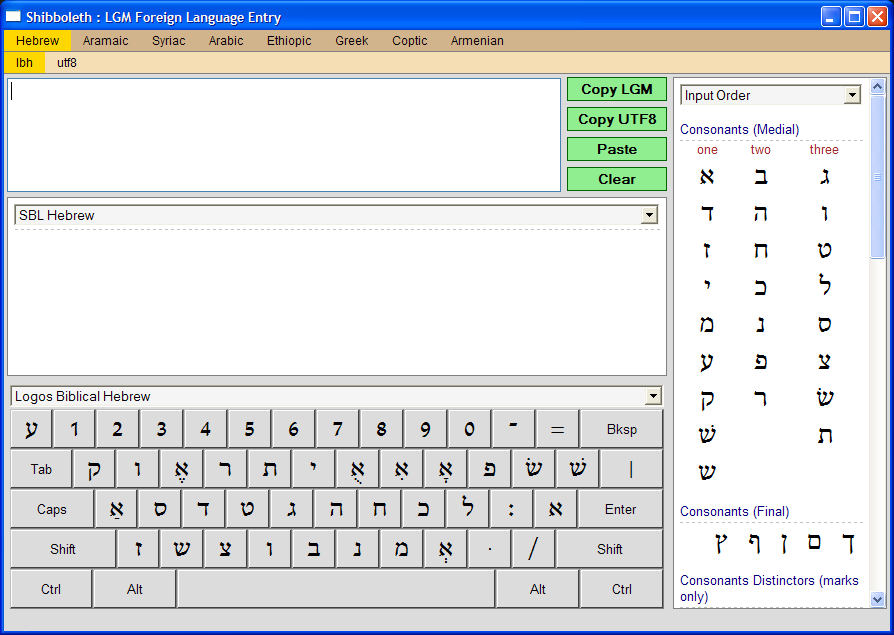
“I’m a whiteboard elf,” the programmer explained. Like the shoemaker in the fairy tale, I had only to lay out the leather. The elves then made the shoes overnight.
I miss programming. I miss creating something from nothing, turning an idea into a product. Like so many entrepreneurs, I no longer exercise the skills that enabled me to start the business.
The upside is that my business is no longer constrained by my skills and capacity. Our programmers are more talented than me and the team is able to produce more than I ever could alone.
I loved being a software shoemaker, doing everything myself, and sometimes I miss sewing the shoes. But having a talented team of whiteboard elves is pretty fun, too.
Posted by Bob Pritchett at 7:00 AM | TrackBack
December 1, 2005
Blogging a Start-up
One of the coolest things about the Internet is finding people you had lost touch with. I grew up with the Kamholz brothers, who lived two doors up the street, but have only seen them once since I moved west during college. We reconnected over the Internet, though, and now we follow each others' careers and families online.
Andrew Kamholz recently started a new company, and he is blogging it every step of the way. Yesterday's post on cash flow and the blow to personal pride involved in having to put in more personal funds brought back lots of unpleasant memories for me. It is also an example of the 'full disclosure' that makes his blog great reading.